
INVESTING IN DJIBOUTI: LEGAL ISSUES & BUSINESS OPPORTUNITIES
Investing in Djibouti: a strategic market, real opportunities, and rules to master.
Imagine a country slightly smaller than Belgium generating over $400 million a year from its port revenues alone.
A territory located at the mouth of the Gulf of Aden and the Bab-el-Mandeb Strait, one of the world's busiest shipping lanes, controlling access to the Suez Canal and the Red Sea.
Welcome to Djibouti, the little-known strategic hub transforming East Africa.
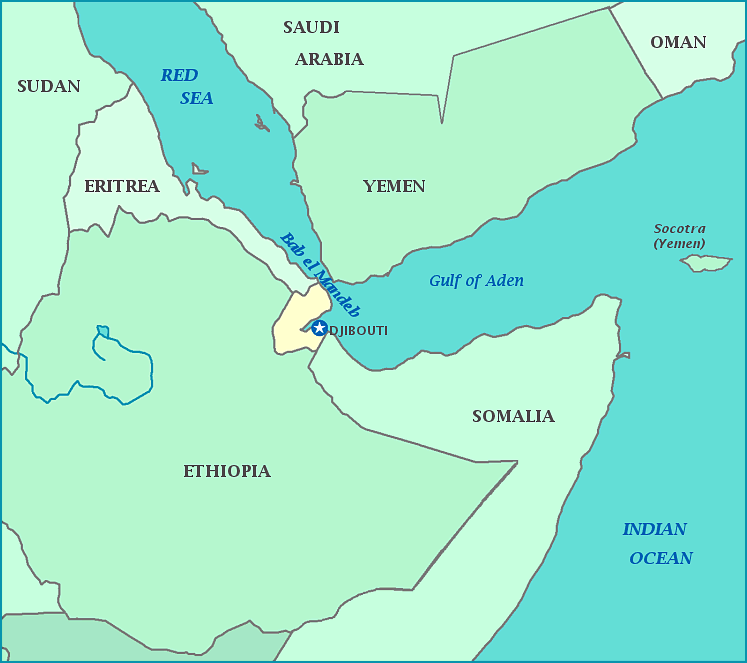
As a strategic crossroads between Africa, the Middle East and Asia, Djibouti is a key investment destination in the Horn of Africa.
Over the past twenty years, Djibouti has enjoyed strong economic growth thanks to investment in infrastructure, its exceptional geographical position and political stability in a globally unstable region.
Today, this small nation of around one million inhabitants is the gateway to a market of 350 million consumers in East Africa, through the COMESA free trade zone.
Ultra-modern ports, attractive free trade zones, connected infrastructures... Djibouti represents a unique opportunity for international managers and investors looking for new growth territories.
The country aims to become a regional hub for trade, telecommunications and finance by 2035. Its "Vision 2035" strategic and economic plan is built around5 pillars :
- Peace
- Good governance
- Economic diversification
- Human capital development
- International cooperation & regional integration
However, like any emerging market, Djibouti has its own legal, economic and cultural specificities that you need to master to set up successfully.
In this article, we provide you with an overview of business opportunities in Djibouti, as well as best practices for securing and optimizing your investment project.
5 strategic advantages that make Djibouti an economic Eldorado
1. A geographical location at the crossroads of three continents
Djibouti occupies the most strategic position in the Horn of Africa.
Located at the intersection of the Red Sea and the Gulf of Aden, the country controls one of the world's busiest trade routes.
It is a key point on the maritime route between Europe and Asia, and a junction between the Arabian Peninsula and East Africa.
More than 30% of the world's maritime trade passes through this area, which is open to both sea and land.
This privileged position makes :
- The main point of entry to Ethiopia (135 million inhabitants), a landlocked country 95% dependent on the port of Djibouti for its trade.
- A logistics hub for East Africa, providing access to markets in Kenya, Uganda and South Sudan.
- The natural port of entry to COMESA, a market of 350 million inhabitants.
- A gateway to Middle Eastern and Asian markets via China's New Silk Road.
2. First-class modern infrastructures
The country has invested heavily in modern port and logistics infrastructures in recent years :
- The Port Polyvalent de Doraleh (financed by DPFZA and China Merchants Group) can accommodate ships carrying over 15,000 containers and has a handling capacity of 9 million tonnes per year.
- The Djibouti Container Terminal (DCT) is a key transshipment hub for the East African region.
- Horizon Terminal (HDTL) is East Africa's only state-of-the-art oil terminal.
- The Djibouti-Addis-Abeba electric railroad line (756 km), inaugurated in 2018, reduces freight transport time from 3 days to 12 hours.
- Hassan Gouled Aptidon International Airport, a hub for the region, was modernized in 2024.
3. Political stability rare in the region
In a Horn of Africa marked by conflict, Djibouti is an oasis of stability.
This stability is reflected in :
- A reassuring international military presence: French, American, Chinese, Japanese and Italian bases.
- Stable democratic institutions since independence in 1977.
- A policy of neutrality with regard to regional conflicts.
- A robust legal system inspired by French law.
4. An attractive tax environment with Africa's largest free trade zone
Djibouti has developed a fiscal ecosystem that is particularly favorable to foreign companies , with the establishment of several free trade zones, including the Djibouti International Free Trade Zone (DIFTZ), which offers a range of tax and customs incentives:
- Exemption from income tax and all direct and indirect taxes;
- Reduced or exempt VAT in certain sectors;
- No restrictions on repatriation of profits and capital;
- Total customs exemption for goods transiting through the zone;
- Simplified administrative procedures and one-stop shopping.
5. Sustained, predictable economic growth
The figures speak for themselves: Djibouti's annual GDP growth is forecast at 5.1% between 2024 and 2026, with some projections reaching 6.5% in 2024 and 6.6% in 2025, driven in particular by the upturn in port and logistics activities.
This growth is based on :
- Steadily growing port revenues (over $400 million annually);
- The development of the financial services sector ;
- The rise of digital technology and telecommunications ;
- Massive Chinese investment in the New Silk Road.
5 high-potential opportunity sectors
Transport and logistics: the heart of Djibouti's economy
The logistics sector accounts for over 70% of the country's GDP.
Opportunities include :
- Transit and warehousing services
- Road transport to Ethiopia and the region
- Customs and clearance services
- Specialized logistics (pharmaceuticals, food)
Renewable energies: untapped potential
With over 300 days of sunshine a year and constant winds, Djibouti offers enormous potential:
- Solar and wind farms
- Geothermal energy (the country has considerable geothermal potential)
- Green energy storage and distribution
- Green hydrogen projects for export
Technology and telecommunications: the digital future
In addition to its role as a maritime crossroads, Djibouti is a nerve center for the global telecommunications network, with 8 existing submarine cables (linking Djibouti to East Africa, the Middle East, Europe and Asia) and new projects underway.
The development of digital infrastructures and improved access to affordable broadband are opening up major prospects:
- Regional data centers
- Telecommunications services
- Fintech and digital banking
- E-commerce and e-commerce platforms
Financial services: becoming the regional financial hub
The monetary system is based on a currency indexed to the dollar and freely convertible at a fixed rate - a financial system free of any exchange controls, allowing total freedom to transfer funds abroad.
Djibouti's financial and banking sector remains solid, with an increase in the number of commercial banks (13 in 2021, compared with 2 in 2013) and is modernizing rapidly:
- Trade finance banks
- Insurance and reinsurance
- Regional investment funds
- Foreign exchange and transfer services
Tourism & hospitality: capitalizing on our hub position
Djibouti's unique position attracts foreign investment:
- Business hotels and convention centers
- Business services and consulting
- International training and education
- Cruise tourism in the Red Sea
Best practices for successful implementation
Key steps to successful implementation
1. In-depth market research: analyze local and regional demand, identify competitors and assess cultural specificities.
2. Choosing the right legal structure: opt for a legal structure suited to your business. Each option has its advantages, whether you choose to set up a company under ordinary law, a branch or a free zone.
3. Strategic local partnerships: identify reliable local partners to secure or accelerate your development. Building solid partnerships with Djiboutian players, promoting local employment and adopting a sustainable development approach are essential levers for integrating and sustaining your business.
4. Compliance with regulations: Djiboutian law is based on the French system, but has its own specific features. On-site legal support is essential to secure every stage of your project.
Mistakes to avoid
- Underestimating the importance of personal relationships: Djiboutian culture favors relationships based on trust. More than anywhere else, setting up in Djibouti means understanding and respecting local customs and dynamics.
- Neglecting customs aspects: even in a free zone, certain procedures remain complex.
- Ignore climatic issues: adapt your equipment to local conditions (heat, salinity).
- Don't anticipate administrative delays: allow 3 to 6 months for a complete set-up (excluding tax-free zones).
The crucial importance of local legal support
A well-structured layout limits risks and optimizes project profitability.
The success of your investment project in Djibouti largely depends on the quality of your legal support.
An experienced local firm will help you :
- Navigate effectively in Djibouti's regulatory environment.
- Optimize your tax structure and take full advantage of the benefits available.
- Secure your contracts with local partners and public authorities.
- Anticipate regulatory changes that could impact your business.
The final word: an adventure to be prepared for in advance
Investing in Djibouti means betting on a territory with a bright future and contributing to its regional development.
Djibouti today offers real prospects for foreign companies wishing to invest in a fast-changing environment. Its strategic location, growth sectors and tax advantages make it an attractive regional hub.
CSR (Corporate Social Responsibility) is increasingly valued and constitutes a differentiating criterion in the region. Focusing on projects with a positive impact (training, environment, inclusion) enhances a company's reputation and facilitates its integration into the economic and social fabric of Djibouti.
For lasting success, however, it is essential to prepare the site carefully, master the local legal framework and build trusting relationships with local players.
➡️ Are you planning to invest in Djibouti? Our expertise in Djiboutian business law and our mastery of international standards guarantee you tailor-made legal support to turn your project into a success.
Since 2016, AYMAN SAID LAW FIRM has been assisting local and multinational companies with their legal issues in Djibouti. Your legal ally for a successful establishment.
Contact us today for an initial consultation and find out how to make your investment project in Djibouti a reality.
📞 +253 21 35 47 02
📍 Rue Bourhan Bey, B.P. 2069, Djibouti